

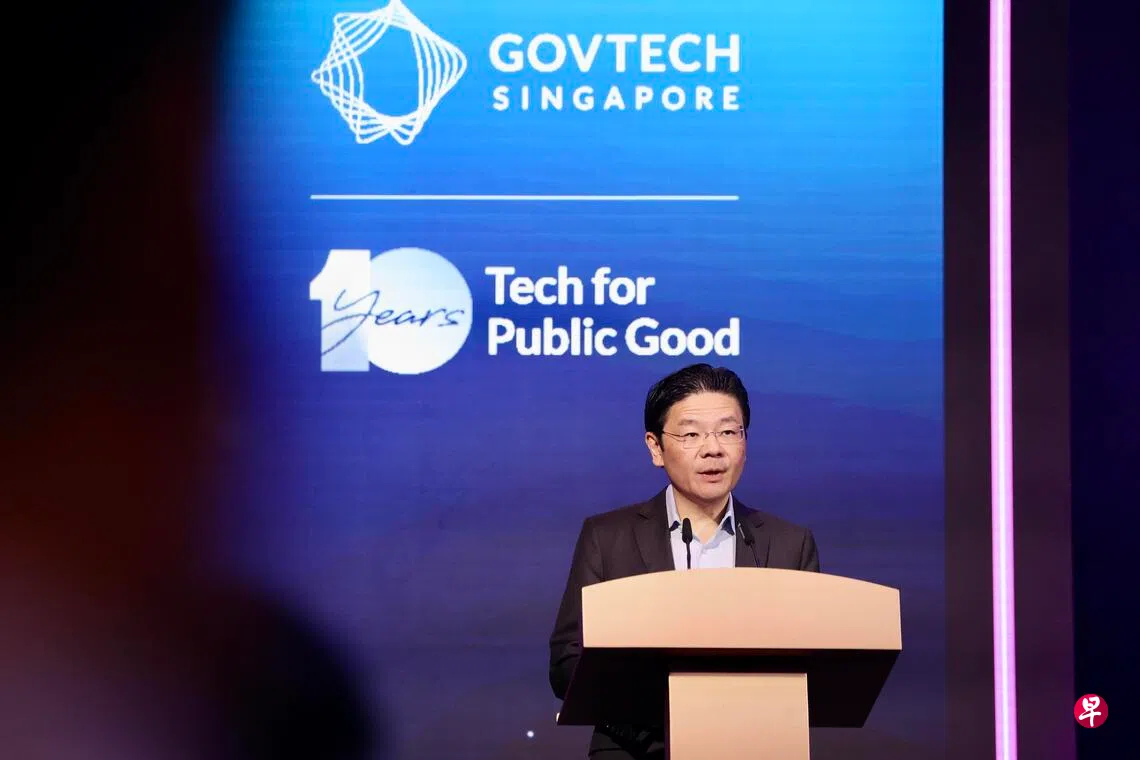
Technology can no longer be merely a tool for implementing policy, but must be integrated into policymaking from the outset. Prime Minister Lawrence Wong said the next phase of the government’s digital transformation must change how policies are made, teams are organised and public services are delivered, ultimately building a technologically stronger government.
Speaking at GovTech’s 10th anniversary dinner on Thursday (5 November) evening, Wong stressed that the agency would play a key role in this transformation.
He said: “Over the past decade, GovTech has helped transform the way government uses technology. In the next decade, GovTech must help transform the way Government itself works.”
Wong said policies must not only be well conceived but also workable, and technology is key to putting them into practice. Yet information technology has long been treated as a downstream part of policymaking, with technology teams often brought in to develop systems only after decisions have been made.
He said this was a mindset that needed to change across the government. GovTech staff must not simply implement policymakers’ requests, but become active partners in solving public policy problems.
“Sometimes, the best solution is not more sophisticated technology, but a simpler policy.”
For example, the Accounting and Corporate Regulatory Authority (ACRA) previously had 33 different penalty combinations for late filings. Rather than building a system around these complex rules, the team first simplified the policy itself, reducing the 33 combinations to just four. The result was a simpler policy, a simpler system and better outcomes.
Wong said the cumulative impact could be considerable if this approach were adopted across the government.
He said: “Changing established habits and ways of working will take time. But the direction i s clear. Technology can no longer be an afterthought in policymaking. It must be part of the process from the very beginning.”
Wong stressed that all these changes ultimately depended on people, whether they involved integrating policy and technology, changing development methods, modernising systems or strengthening cyber security.
He said GovTech must continue to be a place where people can deepen their professional skills, tackle difficult problems and do meaningful work. This also means the agency must continually refresh its own capabilities.
In July this year, GovTech announced a two-year workforce transformation to be carried out in three phases. It will retrench 7% to 9% of its staff, or between 270 and more than 350 people.
Wong said this was a difficult period for some staff. The government would continue to support those affected, helping them acquire new skills and prepare for new opportunities within or outside GovTech.
Goal is not just a strong technology agency, but a technologically strong government
However, refreshing GovTech’s capabilities is only part of the task. Wong said Singapore must also build stronger technological capabilities across the wider public service.
“When we established GovTech, we deliberately concentrated the expertise in one organisation, so that we could quickly build up a critical mass of talent and capabilities. But expertise cannot reside in GovTech alone. It must be deeply embedded across the entire Public Service.”
Over the past year, GovTech has advanced product development and brought engineering capabilities closer to frontline agencies.
The agency will continue to deepen this work while serving as a centre of excellence, setting high standards and tackling complex technological challenges that individual agencies would struggle to address on their own.
Wong said: “Because ultimately, our goal is not simply to have a strong technology agency. It is to have a technologically strong Government.”
“A Government where technology is integral to policymaking; where policymakers understand what technology can enable; where technologists understand the policy objectives and operational realities; and where both work together to deliver better outcomes for Singaporeans.”
