

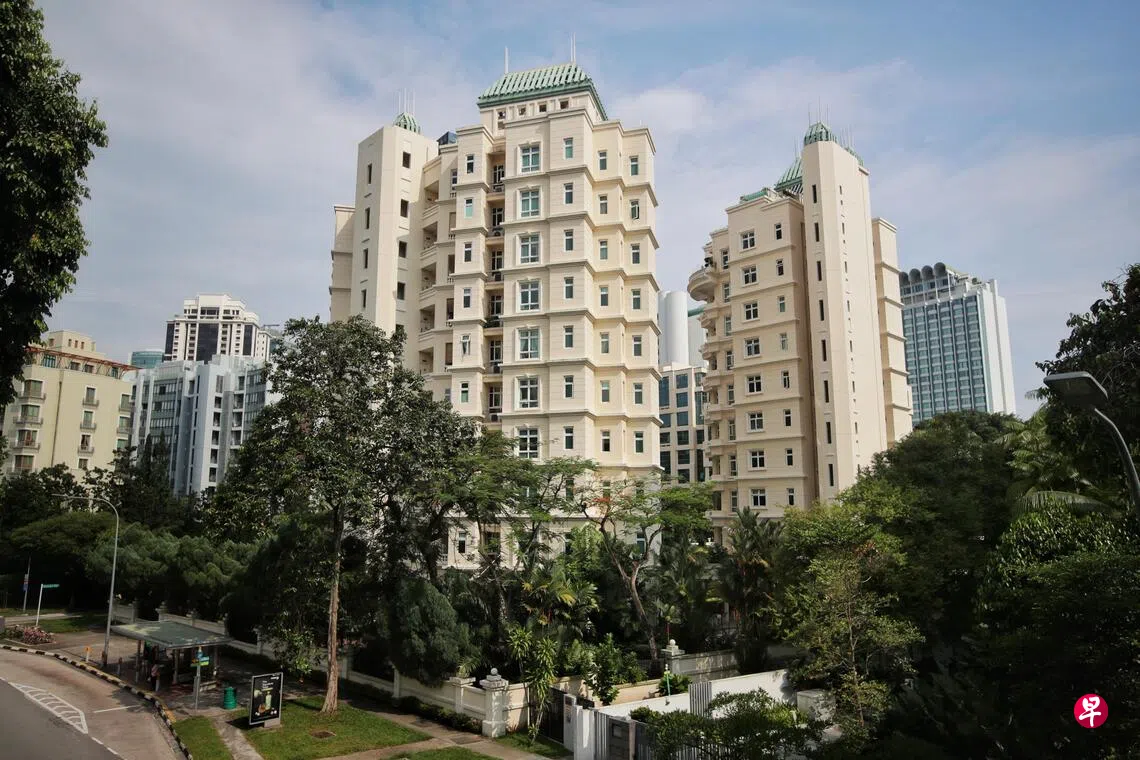
The bankruptcy of “oil tycoon” Lim Oon Kuin and his children has sparked another court case. His grandson claimed that his late mother had an agreement with her elder sister under which a condominium unit worth more than S$4 million, registered in the sister’s name, belonged to his mother. He sought to recover the asset from the trustees handling the bankruptcy, but the High Court dismissed his claim.
The disputed unit is at Chelsea Gardens in the Stevens Road area. It was bought in 1997 for S$3,819,270 by Lim Huey Ching, 59, the eldest daughter of Hin Leong Trading founder Lim Oon Kuin, 84. The development received its Certificate of Statutory Completion in August 2001. Lianhe Zaobao understands that her unit is now worth more than S$4 million.
The claimant, Denzel Pak Juin Tern, is Lim Oon Kuin’s grandson. His late mother, Lim Huey Yih, was Lim Oon Kuin’s second daughter and died in June 2017. Pak filed the legal action as administrator of his mother’s estate, claiming that his aunt, Lim Huey Ching, held the Chelsea Gardens unit on behalf of his late mother. He sought a court declaration that the unit formed part of his mother’s estate rather than his aunt’s bankruptcy estate.
Lim Huey Ching, her father Lim Oon Kuin, and her brother Lim Chee Meng, 56, were declared bankrupt in December 2024, with their assets placed under the management of private trustees in bankruptcy. The two defendants in this case were Lim Huey Ching’s trustees in bankruptcy, Leow Quek Shiong and Seah Roh Lin.
According to the High Court’s judgment issued on 5 November, Pak said his mother, Lim Huey Yih, told the family in 2000 that she intended to buy a private home for herself and her son after her divorce, and hoped to live near her elder sister. Lim Huey Ching had then bought a Chelsea Gardens unit, which happened to be just the right size for Pak and his mother. The family therefore agreed that Lim Huey Yih would take over the unit, while Lim Huey Ching would buy another apartment at Chelsea Gardens.
Pak said Lim Huey Ching was unable to transfer the unit into Lim Huey Yih’s name because the developer did not allow buyers to change the name on the property immediately after signing the Option-to-Purchase. After discussions, the family decided that Lim Huey Ching would remain the nominal owner, holding the unit on her younger sister’s behalf, while Lim Oon Kuin would initially pay the full purchase price.
The claimant said Lim Huey Yih subsequently used dividends from her holdings in two shipping companies to repay Lim Oon Kuin in full. The accounts given by Lim Oon Kuin and Lim Huey Ching also supported the claimant’s position.
However, Judicial Commissioner Low Siew Ling, who heard the case, noted that the claimant had failed to produce sufficient documentary evidence, such as legal documents, emails or text messages, to support his account. While family members might not formally document a trust arrangement, she found it implausible that, if the agreement existed, the Lim family had not exchanged a single text message over the past 20 years that could substantiate it.
The Judicial Commissioner noted that the claimant’s assertion that the developer prohibited buyers from reselling their properties after signing the Option-to-Purchase could only explain why the unit was not initially registered in Lim Huey Yih’s name. It did not explain why Lim Huey Ching had still not transferred ownership to her younger sister after completing the purchase.
Moreover, bank account records and other documents showed that Lim Huey Ching had paid the unit’s property tax and maintenance fees up to 2024. Her accounts in other court proceedings, including the bankruptcy case, were also inconsistent with the accounts in this case. In addition, the unit was not listed among Lim Huey Yih’s assets after she died in 2017.
After considering all the evidence, the Judicial Commissioner dismissed Pak’s claim. She said: “At the end of the day, their conduct supports a strong inference that the present action was brought not to vindicate any proprietary right of the Deceased or Mr Pak in the Property, but in a last‑ditch attempt to place the Property beyond the reach of Ms Lim’s creditors.”
