One key condition for Singapore’s ability to deploy nuclear energy is whether it can build a deep geological repository for nuclear waste. A preliminary study has found no barriers to this, but further geophysical studies are needed to assess more comprehensively the technical feasibility of various deep geological disposal options.
Singapore has yet to decide whether to deploy nuclear energy, but has been actively committing resources in recent years to building capabilities and advancing research in the field, including nuclear waste management.
In response to queries from Lianhe Zaobao, the Energy Market Authority (EMA) said it and the National Environment Agency commissioned SKB International, a Swedish pioneer in dealing with nuclear waste, in 2023 to study the potential implications of nuclear waste management for densely populated Singapore, and identify best practices for storing and disposing of nuclear waste.
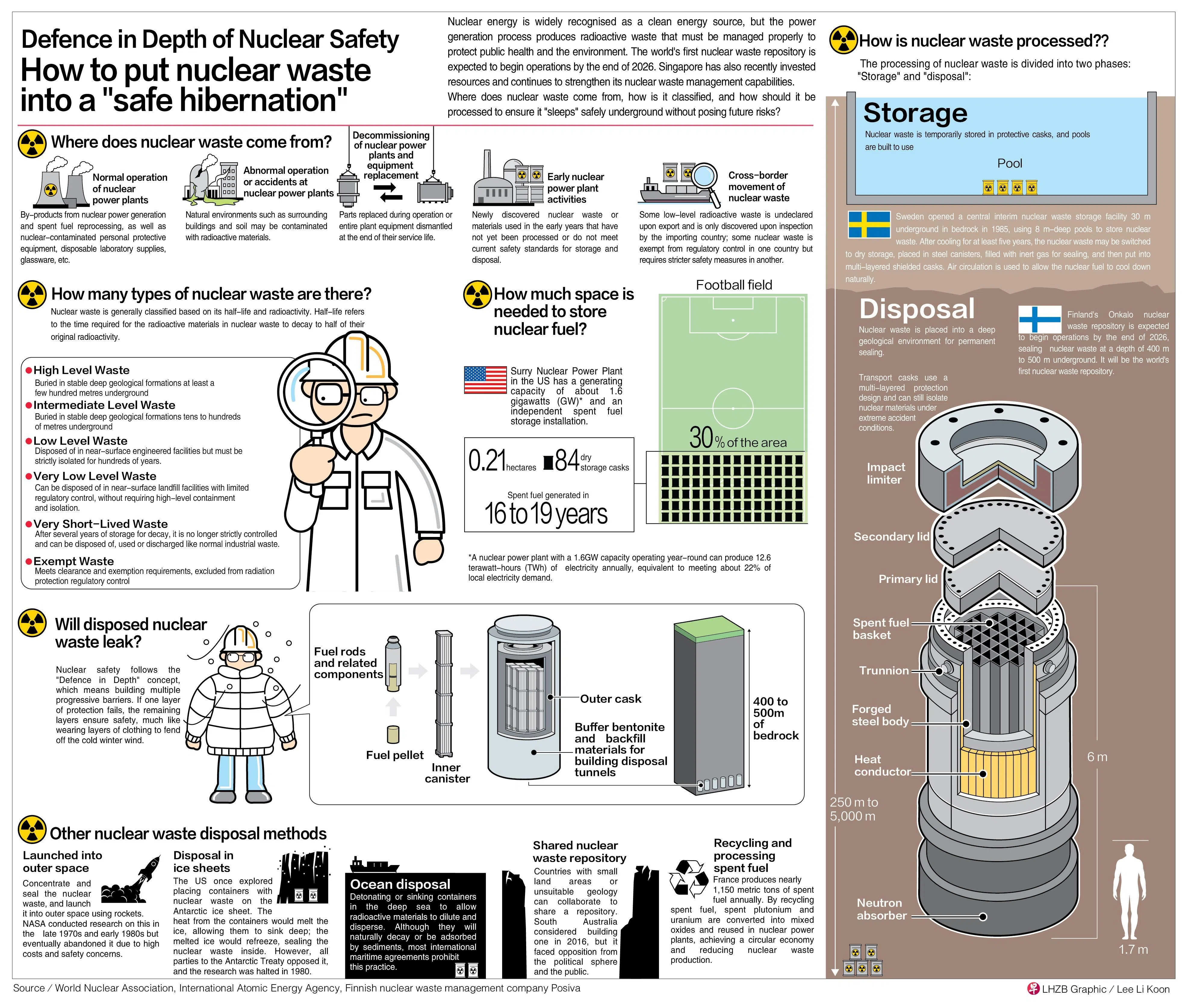
The desktop study used publicly available geological data to assess various deep geological repository options for disposing of high-level radioactive waste. These repositories use a defence-in-depth design with multiple barriers, typically comprising three layers of protection — engineered, geotechnical and geological barriers — to prevent radioactive material from leaking.
The study found that if Singapore decides to deploy nuclear energy, the total volume of radioactive waste generated is expected to be small. Nuclear waste management strategies used for conventional nuclear power plants would also be applicable to small modular reactors. Overall risks associated with radioactive waste management are low and can be further reduced through radiation shielding and containment designs.
Although the preliminary study found no factors that would prevent the construction of a deep geological repository for nuclear waste, EMA stressed, “To comprehensively assess the technical feasibility in Singapore, additional surveys on Singapore’s geophysical environment will still need to be conducted.”
The authority noted that Singapore has yet to decide whether to deploy nuclear energy, and it is too early to discuss how such surveys and land constraints might affect the construction of a repository. If site investigations are deemed necessary in future, there is extensive international experience to draw on.
Site investigations generally involve assessing environmental factors such as geotechnical conditions, groundwater flows and geological stability to determine whether a nuclear waste repository can be safely built and operated, while also considering the land area required.
EMA reiterated, “We will continue building our capabilities in this area, including collaborating with international experts to understand various waste management solutions and their suitability for Singapore.”
Expert: Nuclear waste requires long-term responsibility, but technical solutions exist
Dr Victor Nian, co-founding chairman of the independent think tank Centre for Strategic Energy and Resources, said that if Singapore eventually decides to deploy nuclear energy, facilities for storing and managing nuclear waste in the short to medium term would likely need to be located here. However, planning for its eventual disposal would require further assessment of geological conditions to develop a long-term strategy.
He said in an interview that land scarcity is a real challenge, but not the biggest obstacle, because the actual volume of nuclear waste would be limited if nuclear power is deployed on a small scale. “What matters more is whether the underground rock formations, water conditions and long-term geological stability are suitable for the safe disposal of nuclear waste. This is also why further geological studies and surveys are so important.”
Dr Nian stressed that the long-term challenges of nuclear waste should not be confused with the question of whether solutions exist. “Nuclear waste is an issue that requires long-term responsibility, not one without technical solutions.”
South Australia considered hosting a shared repository in 2016, but faced political and public opposition. Dr Nian said shared repositories are technically and economically viable, particularly for countries with smaller nuclear power programmes and limited volumes of nuclear waste. However, they still face challenges involving politics, legal liability, cross-border transport and public acceptance.
He noted that a shared regional repository could be an option in future, but Singapore cannot assume in advance that other countries will ultimately take care of its nuclear waste. “The more responsible approach is to first build our own capability to manage nuclear waste safely, while remaining open to international cooperation.”
World’s first nuclear waste repository expected to begin operations by year-end
The world’s first nuclear waste repository is expected to begin operations only at the end of this year. Once operational, the Onkalo facility in Finland will store nuclear waste at depths of 400m to 500m underground.
Most countries currently use a storage approach, temporarily keeping nuclear waste in protective containers and building pools where water shields radiation and cools the waste until repositories are ready. After at least five years of cooling, the containers holding the nuclear waste can be transferred to dry storage.
The Surry nuclear power plant in the US, for example, has an independent spent fuel storage facility covering about 0.21ha. It can hold 84 dry storage containers, enough to accommodate approximately 16 to 19 years’ worth of spent nuclear fuel generated by the plant.
The Surry plant has an installed capacity of about 1.6 gigawatts and can generate approximately 12.6 terawatt-hours of electricity over a full year of operation, equivalent to about 22% of Singapore’s annual electricity needs. If Singapore were to deploy a similar nuclear power plant, the land area needed for nuclear waste management would be small.