

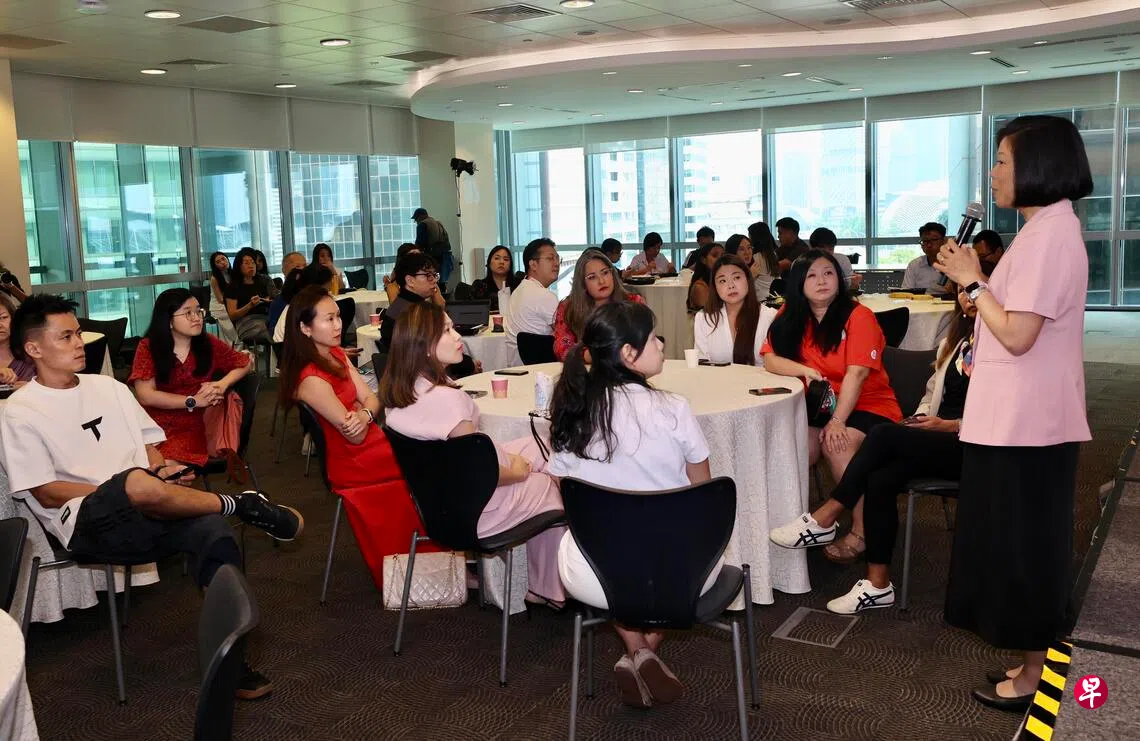
Creating a more supportive workplace for employees undergoing assisted fertility treatment is among the key policy recommendations the People’s Action Party (PAP) Women’s Wing plans to submit to the government’s Marriage & Parenthood Reset Workgroup.
The PAP Women’s Wing held its ninth listening session of the year on Thursday (12 November) to explore how to create workplaces that support employees in having children. Jointly organised with the National Trades Union Congress (NTUC) Women and Family Unit and fertility advocacy group Fertility Support Singapore (FSS), the session drew about 50 men and women, including employees and employers.
Speaking to the media at the event, Women’s Wing chair and Second Minister for Foreign Affairs and Home Affairs Sim Ann said the wing had heard from more than 800 people across nine listening sessions about their hopes and concerns surrounding dating, marriage and parenthood. Topics included the financial considerations of starting a family, balancing family and career, and issues relating to physical and mental health, conception and fertility.
Thursday’s session sought to develop more specific recommendations to better support Singaporeans who want to have children.
Sim said: “For Singaporeans undergoing fertility treatments, they are already committed to the idea of starting a family, and if we are able to provide more support for them, including in terms of getting employers to also buy in to create a more fertility-friendly workplace culture, I think that would make a big difference.”
Sim Ann: Multiple approaches needed to build a family-friendly society
The Women’s Wing will turn the feedback gathered through the listening sessions into policy recommendations and submit them in January next year to the government’s Marriage & Parenthood Reset Workgroup.
Asked about specific recommendations, Sim said building a society that supports families required a whole-of-society effort rather than a single measure. This meant working on several fronts, including fostering family-friendly attitudes in the workplace and providing practical assistance to ease families’ financial pressures and concerns.
FSS founder Lin Shumin said in an interview that, in the course of providing fertility support services, she had encountered many women deeply troubled by the stigma of infertility. A survey found that 41% of affected women chose to leave their jobs, reduce their workloads or move to less demanding roles.
On policy recommendations, she identified the cost of fertility treatment as a major concern and urged people to undergo fertility checks early so that problems could be detected and treated sooner.
Flexible work arrangements were also a concern for many participants at the listening session.
NTUC revamps jobs portal to make flexible work easier to find
From the first quarter of next year, jobseekers looking for flexible work arrangements are expected to be able to find vacancies clearly labelled as offering remote work, flexible hours or flexible workloads on the revamped “Yes, Flex Jobs!” portal. The portal is being updated by NTUC’s Women and Family Unit and the Employment and Employability Institute (e2i).
NTUC Assistant Secretary-General and U Women and Family Director Yeo Wan Ling, who attended the listening session, told the media that vacancies on the portal would include both existing roles and jobs created after NTUC worked with employers to redesign workflows.
She said: “I think that is very important, because we didn't want this to be just one of those run-of-the-mill type of job portals, but one that really is on point on what employees need, and how we can actually support employers in the midst of redesigning their jobs and relooking at their work cultures to support families.”
NTUC will conduct user acceptance testing of the revamped portal on Friday (13 November).
