

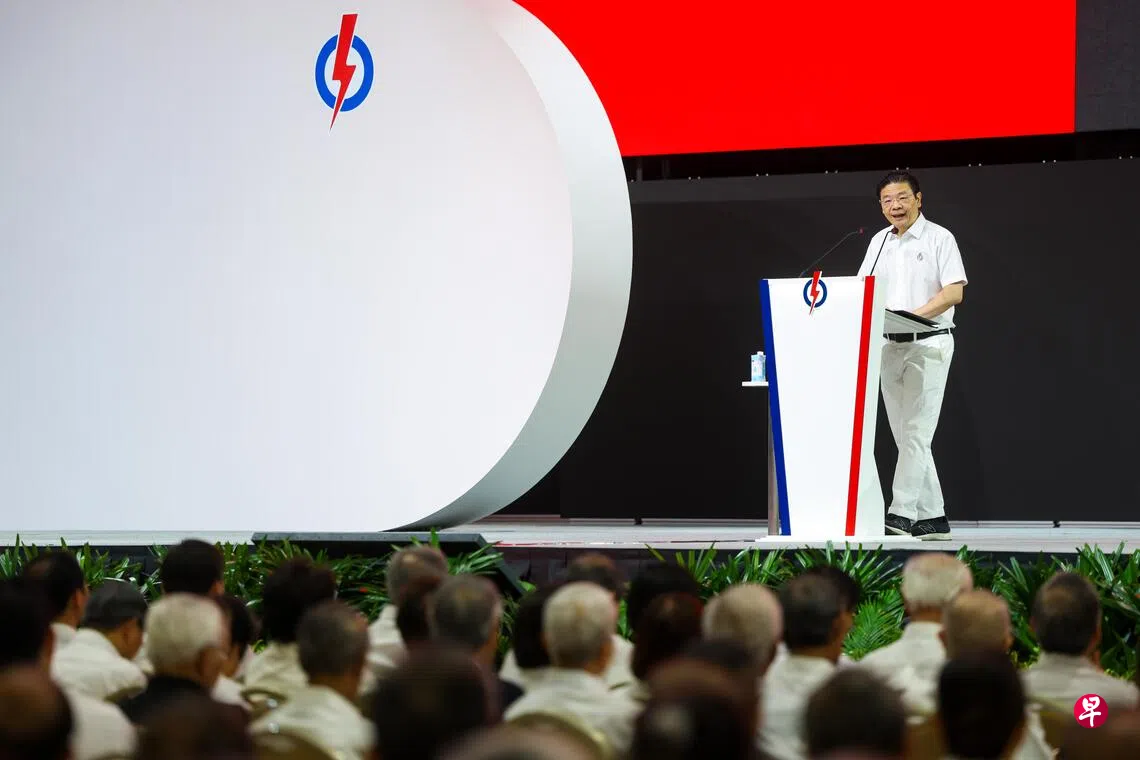
Governing requires foresight and a grasp of the bigger picture, not proposals that appeal in the moment but disregard the consequences. It also demands vigilance against populism and simplistic solutions that sidestep difficult realities and choices.
Prime Minister Lawrence Wong, who is also secretary-general of the People’s Action Party (PAP), said at the PAP Cadre Conference on Sunday (25 October) that governing requires balancing competing needs and interests. It means considering not just those with the loudest voices, but also groups whose concerns receive less attention, as well as the overall interests of Singapore and all Singaporeans.
“Above all, we must never allow our politics to become so divided that we lose the ability to work together for Singapore’s future. That is why, as the governing party, the PAP must always take the wider and long-term view,” PM Wong said.
“You cannot just put forward proposals that sound appealing today. You have to make difficult choices that stand the test of time.”
Citing housing and foreign manpower policies, PM Wong criticised the Workers’ Party (WP) for taking inconsistent positions on some policy issues in the past and shifting its stance with the political winds.
For example, when HDB resale prices fell in 2019, the WP called on the government to build fewer new flats. The COVID-19 pandemic that followed lasted several years, disrupting construction and causing a shortage of new flats. In 2023, the WP then criticised the government for not building enough flats, without mentioning its proposal to reduce construction a few years earlier.
The housing situation has now stabilised, but the government still needs to build more new HDB flats to meet the needs of different groups, including singles, while also protecting and expanding green spaces. PM Wong noted that developing new projects, whether at Sunset Way, Gillman Barracks or other locations, involves difficult trade-offs. No option can satisfy everyone.
“But we must make a choice. And we will choose what best serves Singapore’s wider and longer-term interests.”
PM Wong said these examples showed that the WP’s positions “seem to shift with the political winds”, adjusting to current concerns or what it believes will be popular, without necessarily forming a coherent approach that takes account of policy trade-offs and long-term consequences.
The PAP government’s approach, by contrast, has consistently been to listen carefully, explain policy trade-offs candidly, make decisions and take responsibility for the consequences. Even when difficult decisions are unpopular, the PAP cannot shy away from them, let alone leave the next generation to bear the consequences.
Jamus Lim: Changing positions on sound grounds is a sign of maturity
Jamus Lim, a WP Member of Parliament for Sengkang Group Representation Constituency, later responded in a Facebook post, accusing Wong of “double standards”. He noted that the PAP had also changed its position on several policies, including the “Stop at Two” population policy and the repeal of Section 377A. He added that even the current government had shifted its stance on proposals it had previously opposed, including reducing class sizes and revising Certificate of Entitlement categories.
Lim argued that political parties should be willing to adjust their policy positions when there are sound reasons to do so. If they discover that their original course was wrong, changing their position is a sign of wisdom and maturity, rather than opportunism.
“This is precisely how democracy, at its best, is supposed to work: to be open to feedback, so that collective knowledge is harnessed. It is this sort of back-and-forth debate that refines policy, and keeps it relevant.”
Lim also noted that political parties should not sacrifice their core principles, but neither should they stubbornly cling to outdated policy positions.
He said the WP assesses policy issues based on facts and specific circumstances, rather than being bound by dogma. The party also believes that a fairer, more inclusive Singapore can only be built through a more equitable distribution of society’s resources and greater public participation.
The PAP subsequently responded through Petir, the online edition of its party publication, saying the issue was not whether policies should change, but whether the different positions a party takes form a coherent approach, and whether that party is prepared to confront the trade-offs and consequences involved.
