

Singapore’s bilateral meetings with ministries from any country are intended to advance national interests and foster bilateral relations. It does not raise international law issues, such as illegal settlements in the West Bank, at such meetings without reason.
Senior Minister K. Shanmugam stressed that Singapore builds international relations on the basis of its interests and international rules. It does not, and cannot, advance the international law it respects through the prism of race and religion.
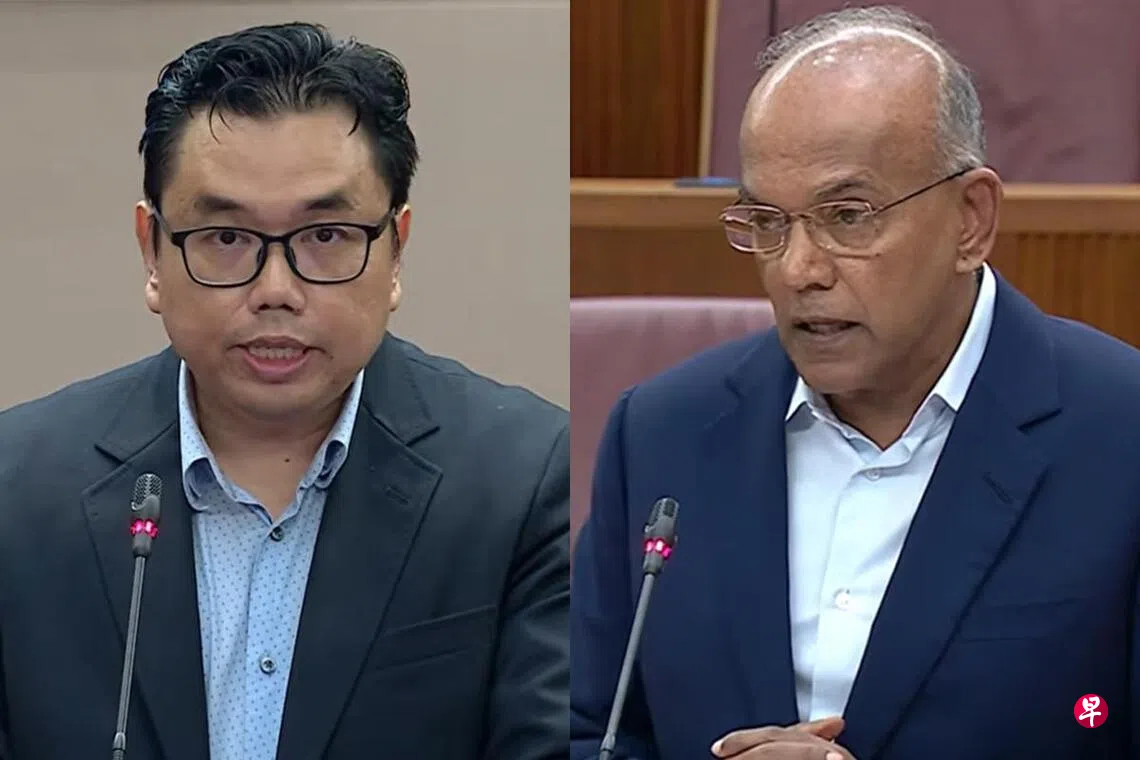
SM Shanmugam, who is also Coordinating Minister for National Security and Minister for Home Affairs, sparred with Workers’ Party MP for Aljunied GRC Fadli Fawzi for about 20 minutes in Parliament on Wednesday (4 November), after oral question time.
Their exchange concerned how the Ministry of Home Affairs (MHA) conveys Singapore’s position on international law issues during bilateral meetings with Israeli officials.
Foreign policy positions conveyed through designated channels, not by individual ministries to counterparts
SM Shanmugam reiterated that Singapore’s positions on foreign policy and international law are conveyed through appropriate channels, such as the Ministry of Foreign Affairs (MFA), rather than by individual ministries to their foreign counterparts.
He questioned whether Fadli’s question was intended to create the impression among the local Malay-Muslim community that the government was unprincipled and soft on Israel.
When Parliament resumed in October, Fadli had submitted a written question asking whether MHA had discussed how to address illegal settlements and settler violence in the West Bank during a recent meeting with an Israeli delegation.
In his written reply, SM Shanmugam said the discussions focused on operational and security matters and did not extend to broader foreign policy issues.
He asked Fadli in return to state his position if he believed MHA should use such exchanges to express concern about the policies or conduct of the countries concerned. Fadli should also explain whether this principle applied only to Israel and how such an approach served Singapore’s overall interests.
Speaking in Parliament on Wednesday, Fadli explained that settler activity and illegal territorial expansion in the West Bank, and especially settler violence, were grave violations of international law and threats to international security.
He said that “when engaging foreign counterparts that may be implicated in such issues”, MHA should raise concerns about their policies or conduct as and when relevant. Operational and technical cooperation in law enforcement and security matters must also be conducted in the context of Singapore’s overall national interests and fundamental principles, including its commitments to international law.
He also cited a report in the Israeli newspaper Haaretz that two officials in the Israeli delegation had links to a settler movement establishing illegal outposts in the West Bank. He therefore believed MHA should explicitly reaffirm Singapore’s principled position during such meetings, and that this principle applied to all countries with which MHA engaged and was consistent with Singapore’s overall interests.
“It is also my belief that when engaging with foreign counterparts, Singapore should maintain a whole-of-government approach in upholding our commitment to international law and a rules-based international order,” Fadli said.
Through the Speaker, SM Shanmugam asked Fadli to clarify whether a whole-of-government approach meant every ministry had to raise international law issues when meeting foreign counterparts, even if MFA had already stated Singapore’s position and the issues were not directly relevant to that ministry.
Fadli repeated his earlier explanation, which SM Shanmugam said did not answer the question.
SM Shanmugam said MFA and the Cabinet as a whole decide Singapore’s overall stance towards any particular country and the scope of bilateral meetings. Subject to that, each ministry deals with directly relevant issues.
He cited the election of Singapore’s Ambassador-at-large and Ambassador for International Law Rena Lee as a judge of the International Court of Justice on Tuesday (3 November).
SM Shanmugam said Singapore’s representatives could not begin by speaking at length about international law, or accusing any party of failing to respect it, when seeking votes from countries in Europe, the US and elsewhere. He remarked that such a position would be “absurd and novel”.
“The fact that international law is important is irrelevant to the question of whether every ministry ought to be raising it with their counterparts.”
SM Shanmugam also accused Fadli of using his question to send different messages to two audiences: presenting himself to the wider public as concerned about national interests, while “trying to create the impression that the government is unprincipled and soft on Israel” among local Malay-Muslims.
“That is what this question and this subsequent explanation is all about. Getting people to view our international relationships through the prism of race and religion. That is just wrong,” said SM Shanmugam.
Fadli stressed that he rejected the characterisation of his question as racially and religiously motivated. He reiterated that his position was primarily about ensuring Singapore upheld its commitment to international law.
In his final response, SM Shanmugam said the primary duty of those elected to serve as MPs and ministers was to safeguard Singaporeans’ interests, not merely to uphold the principles of international law. Upholding international law was important for a small country, but that did not mean repeating Singapore’s position at every meeting. He remarked that “these things are dealt with common sense and skill”.
