

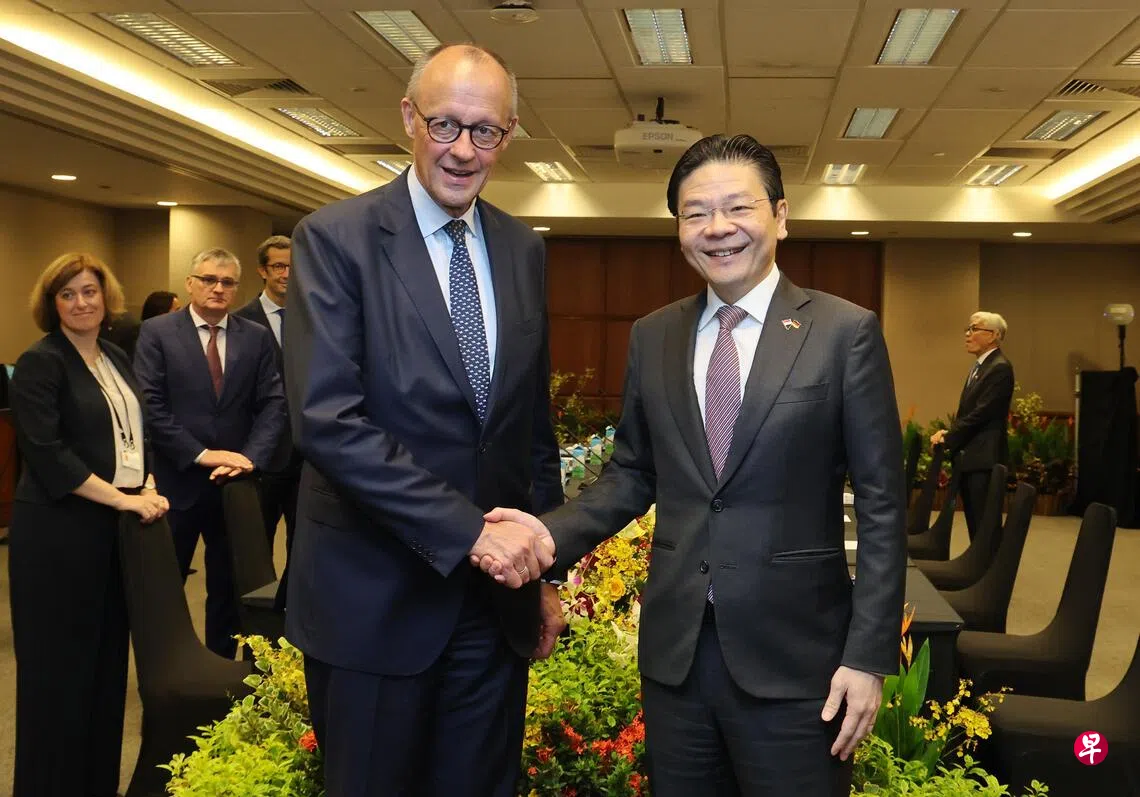
Singapore and Germany will continue to deepen their strategic partnership, which was established two years ago, and expand cooperation into new areas. This includes drawing on their complementary strengths in developing and applying industrial artificial intelligence (AI), and promoting robotics and automated solutions in manufacturing, logistics and other sectors to create new opportunities for businesses and workers.
German Chancellor Friedrich Merz arrived in Singapore on Tuesday (27 October) for a two-day official visit. Following talks, Singapore Prime Minister Lawrence Wong and Merz held a joint press conference to announce a new Joint Declaration and an updated Joint Work Plan for the Singapore–Germany Strategic Partnership.
Singapore and Germany elevated bilateral relations to a strategic partnership in November 2024. Their first two-year Joint Work Plan expires this year.
Singapore’s Ministry of Foreign Affairs (MFA) said in a statement that the new Joint Work Plan is a framework for Singapore–Germany relations that will serve as a forward-looking and ambitious guide for bilateral relations. The Joint Work Plan covers five pillars: Political, Defence, Security and Intelligence; Trade, Investment, Transport and Urban Development; Digitalisation and AI; Research, Science, Technology and Innovation; and Energy Transition, Green Economy and Climate.
Speaking at the joint press conference, PM Wong said Singapore and Germany could do much more together under the strategic partnership, including in the digital economy and artificial intelligence.
PM Wong: Cooperation with Germany can create new jobs for Singaporeans
PM Wong pointed out that digital technology and AI had enormous potential to transform the economy and create new opportunities for businesses and workers, with Singapore and Germany each bringing complementary strengths.
He said Germany was a world leader in industrial capabilities and engineering, while Singapore had also begun investing in digital technology and AI. “If we combine the strengths of our two countries, we can make progress in an area like industrial AI, where we can have more robotics and automated solutions in manufacturing and logistics, or many other areas of the economy.”
PM Wong noted that cooperation between Singaporean and German businesses had benefited many local small and medium-sized enterprises and workers over the decades. As the two countries deepened their partnership, such cooperation would continue to open up new opportunities for local businesses. “As we go about doing so, there will be new jobs created for Singaporeans, and we too will benefit in terms of the skills and training that Singaporeans get in accessing these jobs.”
Singapore and Germany will also cooperate on AI safety through their respective newly established AI safety bodies. The two countries will promote more joint research and innovation projects, including advancing cooperation in AI, advanced manufacturing, green technology, semiconductors, quantum technology and space technology.
Singapore to deepen ASEAN–EU cooperation as ASEAN chair next year
When Singapore assumes the ASEAN chairmanship next year, it will work to deepen ASEAN’s partnerships with Germany and the EU, and advance negotiations on an ASEAN–EU free trade agreement.
PM Wong said working towards a free trade agreement was complex and challenging. However, a growing number of ASEAN member states were negotiating trade agreements with the EU. “That gives us more confidence that ASEAN as a bloc can also make progress in our trade discussions for a free trade agreement with the EU.”
The EU has signed bilateral free trade agreements with Singapore and Vietnam, and is also in negotiations with ASEAN countries including Malaysia, Thailand and Indonesia.
Singapore and Germany will also explore how to draw on the EU–Singapore Digital Trade Agreement and the ASEAN Digital Economy Framework Agreement to connect the EU’s and ASEAN’s digital systems. This would help businesses operate more seamlessly across the two regions and benefit their people.
Germany seeks better integration of regional free trade arrangements to unlock more opportunities
Merz said Germany wanted to further expand trade and investment ties and better integrate its existing free trade arrangements with regional partners, opening up more opportunities in the region for Germany and its businesses.
Merz also expressed support for closer cooperation between Europe and ASEAN countries, saying that “given the fundamental changes that have occurred in our world, we have come to realize how valuable these relations are to us. … given the changed global circumstances, we stand a very good chance of achieving an even deeper cooperation with the countries of the region.”
Faced with an increasingly complex and volatile world, PM Wong and Merz both stressed that Singapore and Germany should work more closely together.
PM Wong hosted a welcome ceremony for Merz at Parliament House on Tuesday morning. Accompanied by PM Wong, Merz inspected the guard of honour before attending an orchid-naming ceremony and holding bilateral talks.
According to the MFA statement, PM Wong and Merz reaffirmed the two countries’ “excellent, longstanding and wide-ranging partnership” in areas including the economy, defence, science and technology, and people-to-people exchanges during their talks.
Merz later met President Tharman Shanmugaratnam and attended a lunch hosted in his honour by Senior Minister Lee Hsien Loong.
In a Facebook post on Tuesday, SM Lee said he and Merz had discussed developments in Europe and Asia, as well as the importance of upholding free trade and a rules-based international order amid growing global uncertainty.
