

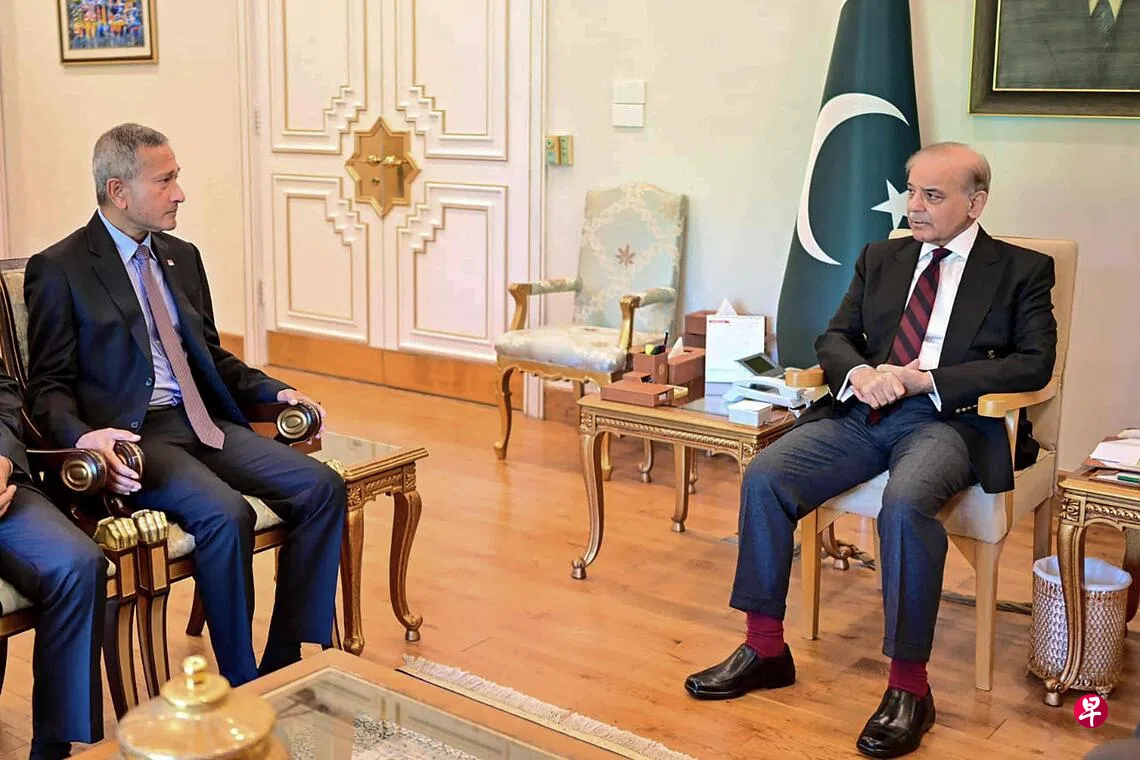
Singapore and Pakistan already enjoy good bilateral relations, and their economic and trade ties should be stronger, Foreign Minister Dr Vivian Balakrishnan said.
Dr Balakrishnan stressed that both countries should make boosting bilateral trade and investment a priority, particularly by strengthening links between small and medium-sized enterprises (SMEs) and businesspeople.
He made the remarks at a joint press conference with Pakistan’s Deputy Prime Minister and Foreign Minister Mohammad Ishaq Dar during a one-day official visit to the Pakistani capital, Islamabad, on Friday (30 October).
Pakistan established diplomatic relations with Singapore on 17 August 1966. Vivian’s visit coincides with the 60th anniversary of bilateral diplomatic ties.
The Ministry of Foreign Affairs said in a statement on Friday that Dr Balakrishnan also met separately with Pakistani Prime Minister Muhammad Shehbaz Sharif and Chief of Defence Forces and Chief of Army Staff Syed Asim Munir.
At Friday’s press conference, Dr Balakrishnan said Sharif had accepted an invitation to visit Singapore.
He noted that Pakistan was among the first countries to recognise Singapore’s independence. The two countries’ top leaders have had opportunities to engage with one another over the years, and bilateral diplomatic ties have always been very good.
“In fact, they are so good that it makes it even more obvious that our trade relations – looking at the numbers and the data – ought to be much higher.”
Dr Balakrishnan said Sharif had also reminded him that Singapore and Pakistan should further strengthen their economic and trade ties and connections. In particular, SMEs and businesspeople from both countries should get to know one another and understand the opportunities and risks in Southeast Asia and South Asia.
Both governments will facilitate and coordinate these interactions and exchanges, while seeking new opportunities for mutually beneficial cooperation.
“In an increasingly uncertain global environment, including on the business side of it, it is even all the more important for our two countries to remain open, connected, and constructively engaged with each other.”
Singapore and Pakistan are also exploring closer cooperation in carbon markets. Dr Balakrishnan said the prospects were promising, with such cooperation potentially attracting investment into sustainable development projects in Pakistan that save energy and reduce emissions.
Separately, the Singapore Civil Defence Force and Pakistan’s National Disaster Management Authority signed a memorandum of understanding committing to cooperation on strengthening disaster prevention and response.
Dr Balakrishnan said no one wished to face a disaster, but threats such as climate change made it necessary to strengthen disaster prevention and build resilience in responding to disasters.
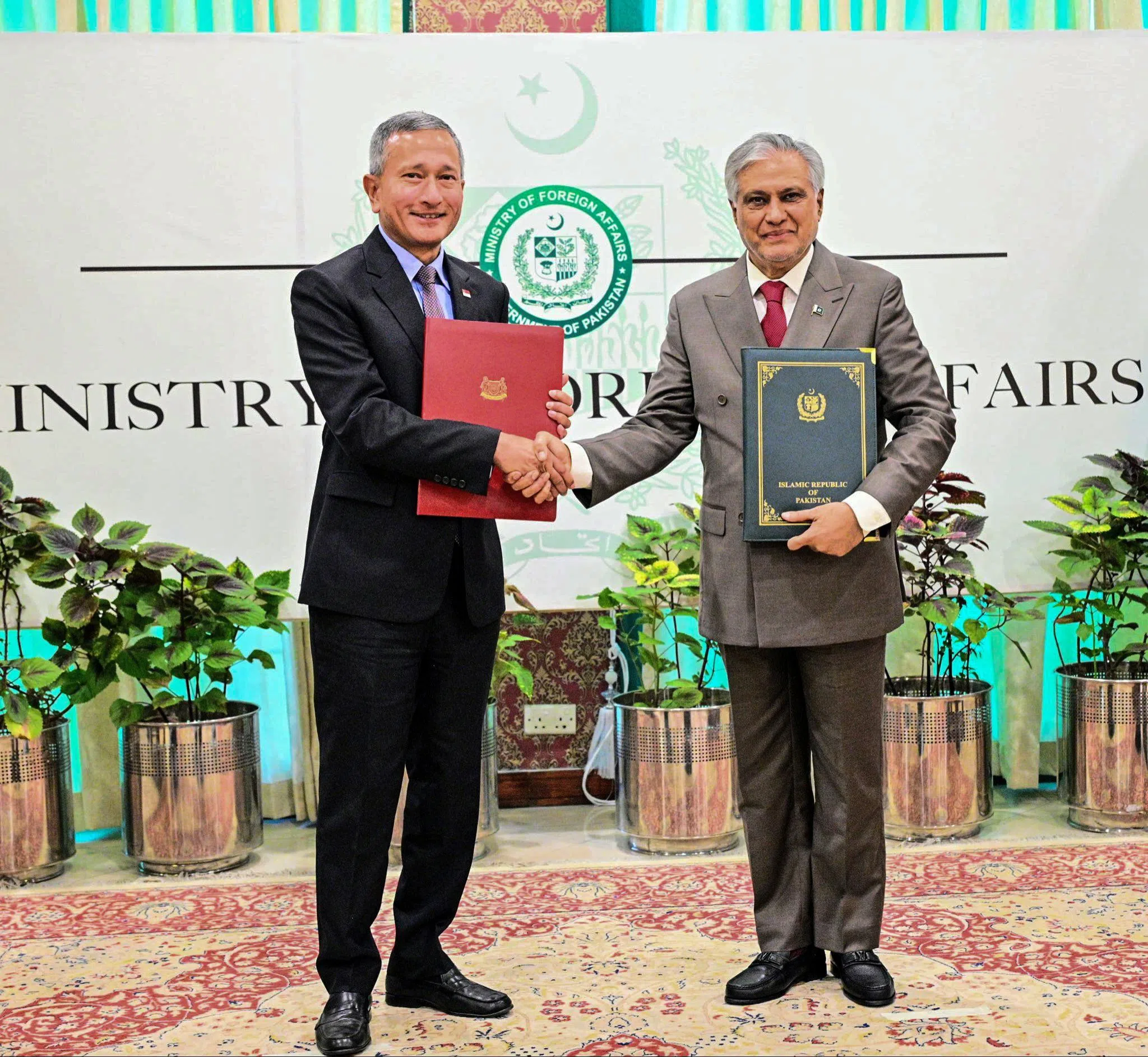
He noted that Pakistan had experience in dealing with major natural disasters, and Singapore could learn much from it. The two countries are preparing to cooperate in areas such as establishing early warning systems, sharing best practices and strengthening search and rescue capabilities. They also hope to conduct joint training and exercises.
Dr Balakrishnan thanks Pakistan for efforts to ease Middle East tensions
On regional and international developments, Dr Balakrishnan thanked Pakistan for its efforts to help ease tensions in the Middle East and avert a greater shock to the global economy.
“The unique, but very constructive and valuable role that Pakistan plays is one which we commend you for, and we wish you every success because if you succeed, it’s good for all of us.”
Dr Balakrishnan stressed that upholding international law was vital to both countries. The United Nations Convention on the Law of the Sea, which safeguards navigational rights and freedoms, including the right of transit passage, was particularly crucial to Singapore. He welcomed Pakistan’s shared position on this issue.
Singapore will assume the ASEAN chairmanship next year, while Pakistan currently chairs the Shanghai Cooperation Organisation’s Council of Heads of Government for 2026–2027. Dr Balakrishnan said this would create new opportunities for the two dynamic and diverse regional organisations to explore further cooperation.
Pakistan is also a sectoral dialogue partner of ASEAN. Dr Balakrishnan said there was considerable scope for Pakistan and ASEAN to strengthen cooperation. He pledged to work closely with Pakistan to strengthen its ties with ASEAN, as well as links between ASEAN and the Shanghai Cooperation Organisation.
Singapore and Pakistan are also exploring expanded cooperation in areas such as education and talent development to help young people in both countries acquire the skills needed in the age of artificial intelligence.
Dr Balakrishnan said both countries welcomed deeper cooperation between their higher education institutions, including Singapore’s Nanyang Technological University and Pakistan’s National University of Sciences and Technology.
Dar hosted Dr Balakrishnan to lunch on Friday. During his visit, Dr Balakrishnan also toured the National Centre of Artificial Intelligence at Pakistan’s National University of Sciences and Technology.
