

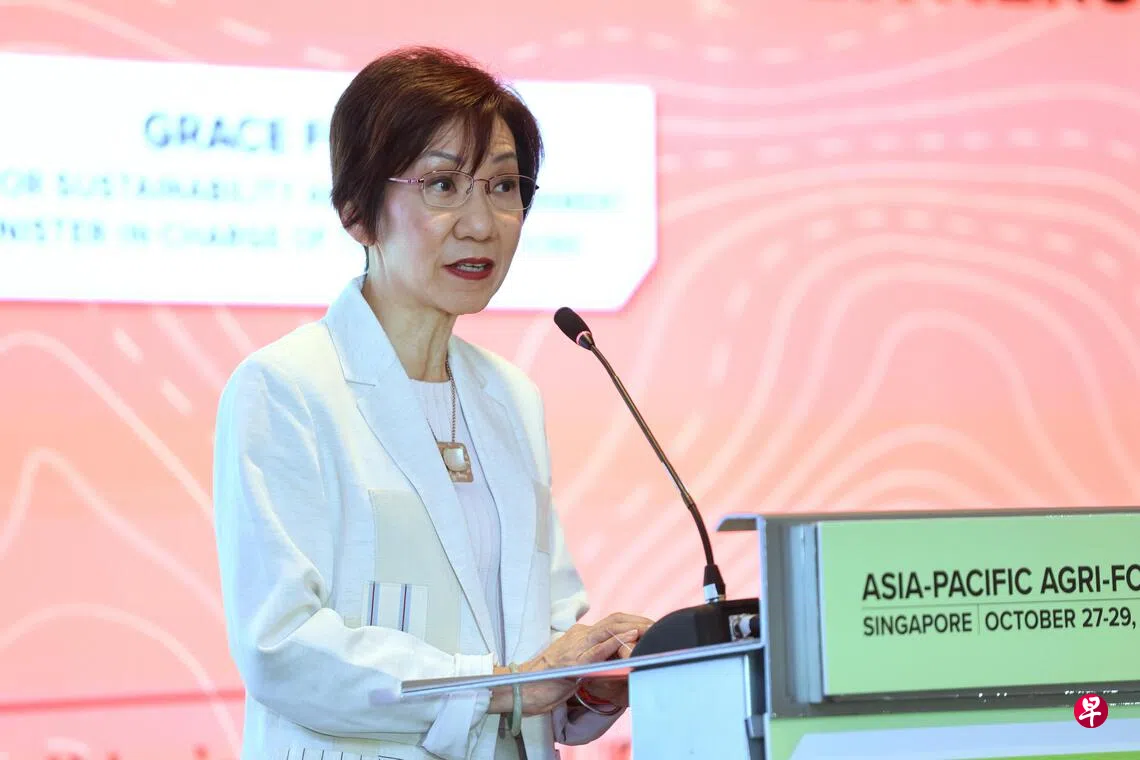
Singapore will allocate $138 million to the next phase of the Singapore Food Story R&D Programme, in support of national development towards 2030.
Minister for Sustainability and the Environment Grace Fu, who is also Minister-in-charge of Trade Relations, made the announcement at Singapore International Agri-Food Week on Tuesday (27 October). The funding is also part of Singapore’s Research Innovation and Enterprise 2030 (RIE2030) plan.
According to the National Research Foundation’s RIE2030 report, released in late August this year, Singapore will invest S$37 billion in RIE2030.
Fu said the latest funding of $138 million will primarily go towards strengthening the resilience of the local food industry and accelerating the development and adoption of solutions that deliver tangible value to the sector. It will cover five key areas: aquaculture, agriculture, future foods, food safety and the newly added area of food supply resilience.
The Singapore Food Story R&D Programme was launched in 2019, with the authorities committing $144 million and $165 million respectively to its first two phases. The latest funding will support the programme’s continued development.
Aquacultural research will focus on genetics, nutrition, health and farming systems to develop higher-yielding, more adaptable fish varieties, improve feed efficiency and enhance fish health.
Agricultural research will focus on seed genetics to improve crop varieties suited to the tropics, as well as cultivation techniques that raise yields and reduce energy consumption.
Under future foods, research capabilities in engineering biology, bioprocessing, and nutrition and sensory science will be further strengthened to make food production more efficient and food more affordable and nutritious.
In the field of food safety, the authorities will further strengthen their ability to identify and assess emerging food safety hazards in Singapore and develop advanced risk assessment methods to safeguard public health.
Under food supply resilience, the focus will be on strengthening the ability to respond to disruptions, more accurately predicting risks and supply disruptions arising from climate change, and developing new technologies to extend food shelf life and improve the management of food stockpiles.
“Across all these areas, our objective is clear: to translate research into practical solutions that can be adopted, scaled and sustained,” said Fu.
She also acknowledged that “Singapore imports more than 90% of our food. We cannot insulate ourselves from global disruptions simply by producing more food locally.”
Fu announced that Singapore would build a more resilient and sustainable food system, bringing farmers, businesses and research institutions together to take promising ideas to market.
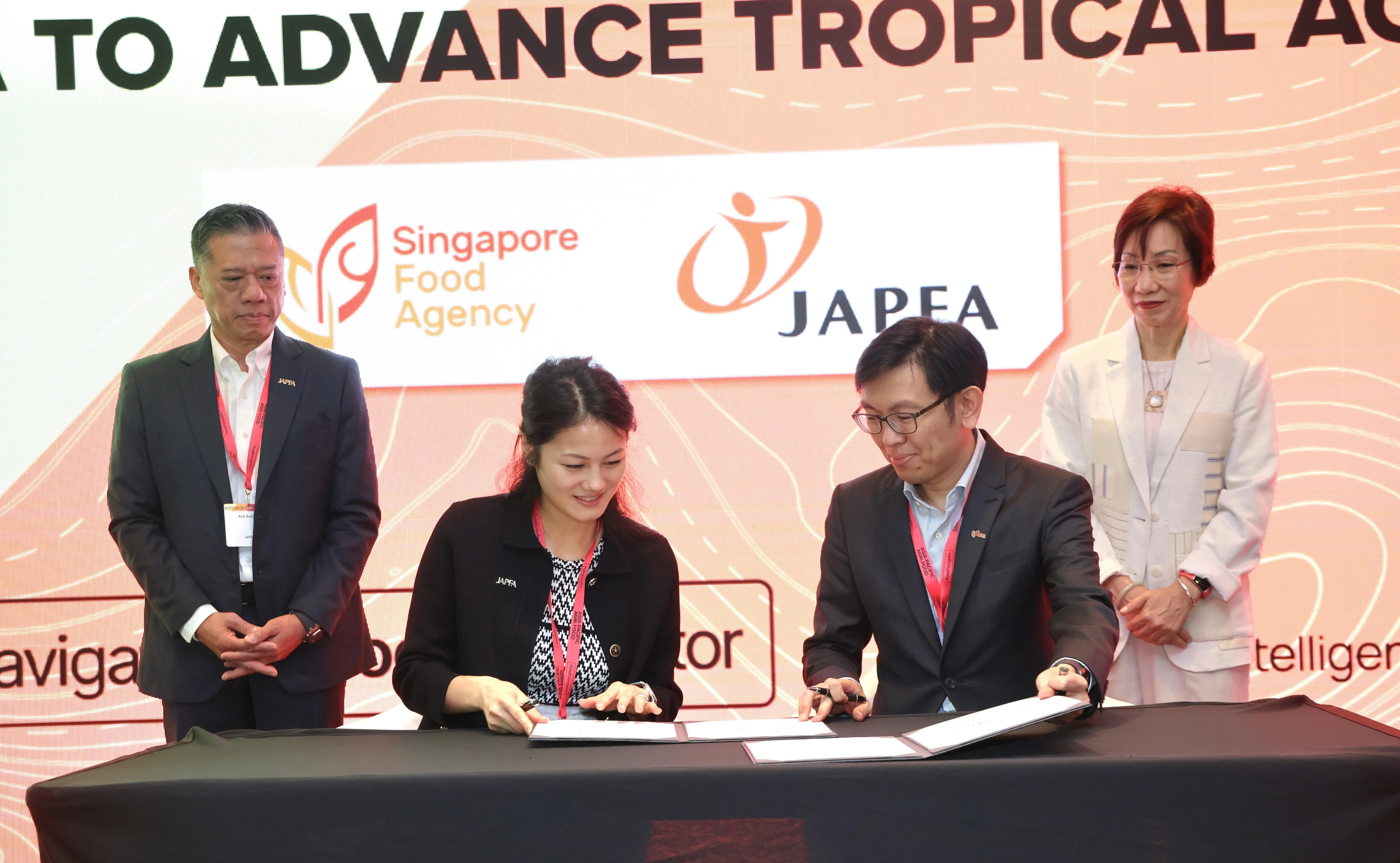
The Singapore Food Agency signed a memorandum of understanding with Japfa Pte Ltd (JAPFA), a leading integrated agri-food company in Asia, to explore and develop strategic research and development partnerships in tropical aquaculture.
Hainan, China-based Hainan Nanfan Seed Industry Group, the National University of Singapore’s (NUS) Institute for Agrifood Innovation and Ventures, and Singapore agritech company Singrow will also sign a tripartite memorandum of understanding on tropical agricultural innovation.
Yu Hao, director of the NUS Institute for Agrifood Innovation and Ventures, told Lianhe Zaobao (LHZB) that the three-way partnership would advance innovative research and development in seed resources for the tropics, particularly those suited to indoor cultivation, as current international research on seed resources focuses mainly on outdoor crops.
“Indoor cultivation can significantly reduce the use of pesticides and chemical fertilisers, while a more controlled environment also helps improve crop traits... But the biggest bottleneck is the high cost.”
Yu said the three parties would work together to develop ways to reduce energy consumption in indoor cultivation and explore cutting-edge agricultural technologies such as genomic selection and gene editing, further lowering cultivation costs and raising productivity.
NUS will primarily be responsible for seed research and development, Hainan Nanfan Seed Industry Group for collecting germplasm resources and producing seeds at scale, and Singrow for testing, evaluating and commercialising new varieties.
Yu explained that genomic selection allows researchers to gain an overview of crops’ genetic information in advance, speeding up the selection of crops with better traits for breeding.
Gene editing differs from genetic modification: the latter involves introducing foreign genes into crops, while the former improves the functions of crops’ own genes and is relatively safer.
Beyond these partnerships, the authorities will also support and advance the development of smallholder farmers through the proposed Solutions Centre for Regional Smallholder Farmers (SCS).
