

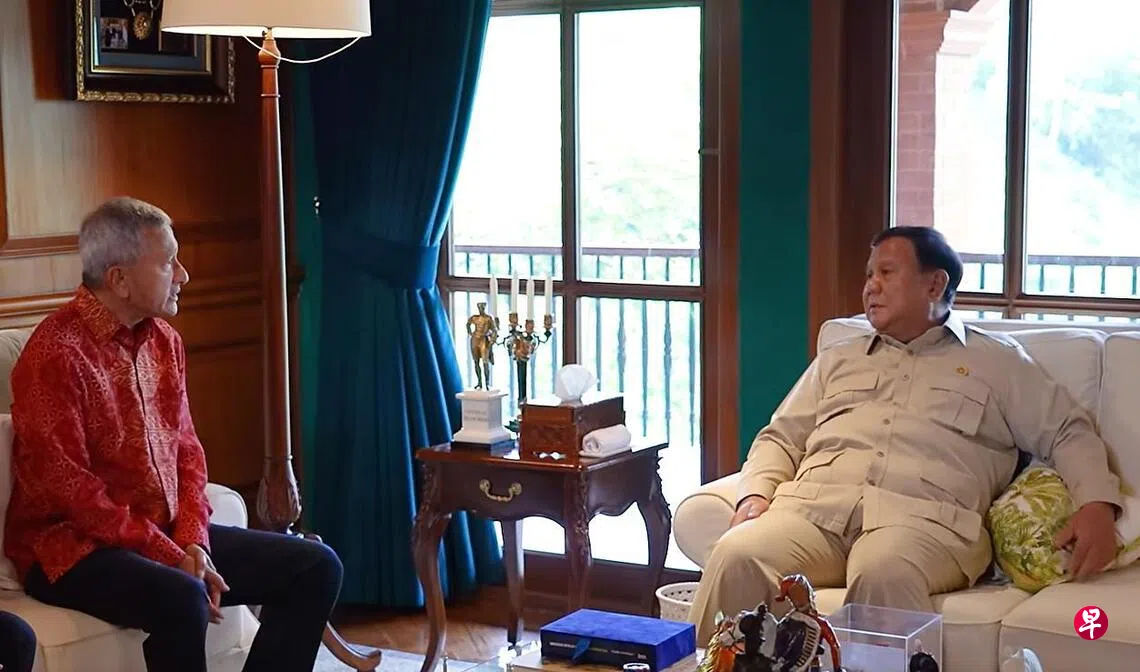
Neighbours face common threats and challenges, and when differences arise, it is important to respond calmly and hold direct, candid and constructive talks, said Foreign Minister Dr Vivian Balakrishnan.
He also said that statements by Singapore and Indonesia on Indonesia’s cuts to natural gas supplies to Singapore reflected both countries’ commitment to upholding the sanctity of contracts.
Speaking to Singapore media during a visit to Jakarta, Indonesia, on Wednesday (28 October), Dr Balakrishnan said the haze had caused concern, anxiety and anger among Singaporeans in recent weeks. He expressed how the government understood these feelings and had to respond.
He said his visit was aimed at ensuring direct, high-level communication between governments on transboundary issues, while seeking constructive, cooperative solutions.
Discussing the state of bilateral relations, Dr Balakrishnan said Singapore and its neighbours — Indonesia, Malaysia and Brunei — face common threats and challenges, but have different priorities and approaches, and it was precisely at such moments that they should remain calm and hold direct, frank and constructive talks to seek a collective approach.
On the haze, this meant deterring and identifying offenders, and doing everything possible to reduce the likelihood of such incidents recurring. Dr Balakrishnan said, “We need to look at this with some equanimity. Differences are to be expected, even polemic statements sometimes, from time to time. But the Singapore way is to be prepared, to be constructive, and to be quietly confident. And I think we will get through this again, in our usual Singapore way. I’m confident of that.”
Meeting with Prabowo establishes Singapore and Indonesia’s “political commitment to take necessary action”
Before the media interview, Dr Balakrishnan met Indonesian President Prabowo Subianto earlier on Wednesday at the president’s private residence in Hambalang, West Java.
Dr Balakrishnan said he was not at liberty to discuss details of the talks, but added: “Singapore’s Prime Minister (Lawrence Wong) and President Prabowo have communicated at the highest level. This sets the political commitment on both sides to do what is necessary, and now we have to implement those plans, execute that commitment.”
Singapore and Indonesia had just announced on Tuesday (27 October) the establishment of a joint task force to coordinate closely and share information on holding companies involved in forest fires accountable.
Dr Balakrishnan said in the interview that the task force’s terms of reference included exchanging information and facilitating each authority’s work in its respective jurisdiction. He was not yet in a position to provide further details about the task force’s composition and staffing, but stressed: “Given the commitment at the senior level for both countries, we will get this done quickly, promptly, and effectively.”
As transboundary haze from forest fires in Indonesia raised concerns among its neighbours, Indonesia abruptly announced cuts to natural gas exports to Singapore last Saturday (24 October). Indonesia’s Coordinating Minister for Downstream Industry and Energy Transition Bahlil Lahadalia subsequently said on Monday (26 October) that the export cuts did not constitute a breach of contract, adding that Indonesia respected contracts.
Asked about Indonesia’s cuts to natural gas supplies, Dr Balakrishnan said a close reading of statements by Singapore’s and Indonesia’s leaders and ministers showed that both sides were, in fact, jointly committed to upholding the sanctity of contracts. He found this encouraging.
He said, “All sides understand that there is a reason why signatures and contractual obligations matter, and it goes beyond the individual subject, but it goes to the credibility and the competitiveness of the economies on both sides.”
As global energy supplies tighten, resource nationalism is again on the rise. But Dr Balakrishnan said working together and looking after domestic needs were not mutually exclusive. Every government has a responsibility to look after its people and ensure that essential supplies, including energy, are available to its people and economy. However, countries could gain greater value by working together to achieve economies of scale and reduce production costs.
“Working together and looking after your own needs is not either or. It’s not a binary,” he said. “To me, the path of least regret is to continue investing, continue partnerships, continue making contingency plans, and to expand the scale of our national and regional infrastructure. This is how you both prime your country to be ready for the opportunities, as well as to be ready for the contingencies which will occur from time to time.”
Whether dealing with the haze or uncertainties in energy supplies, Dr Balakrishnan said these events again underscored the importance of preparation. “This habit of being prepared, making preparations way in advance, and also having diversified sources of energy and essential supplies, also enables us, when the time comes, to cope calmly, comprehensively, and confidently.”
