

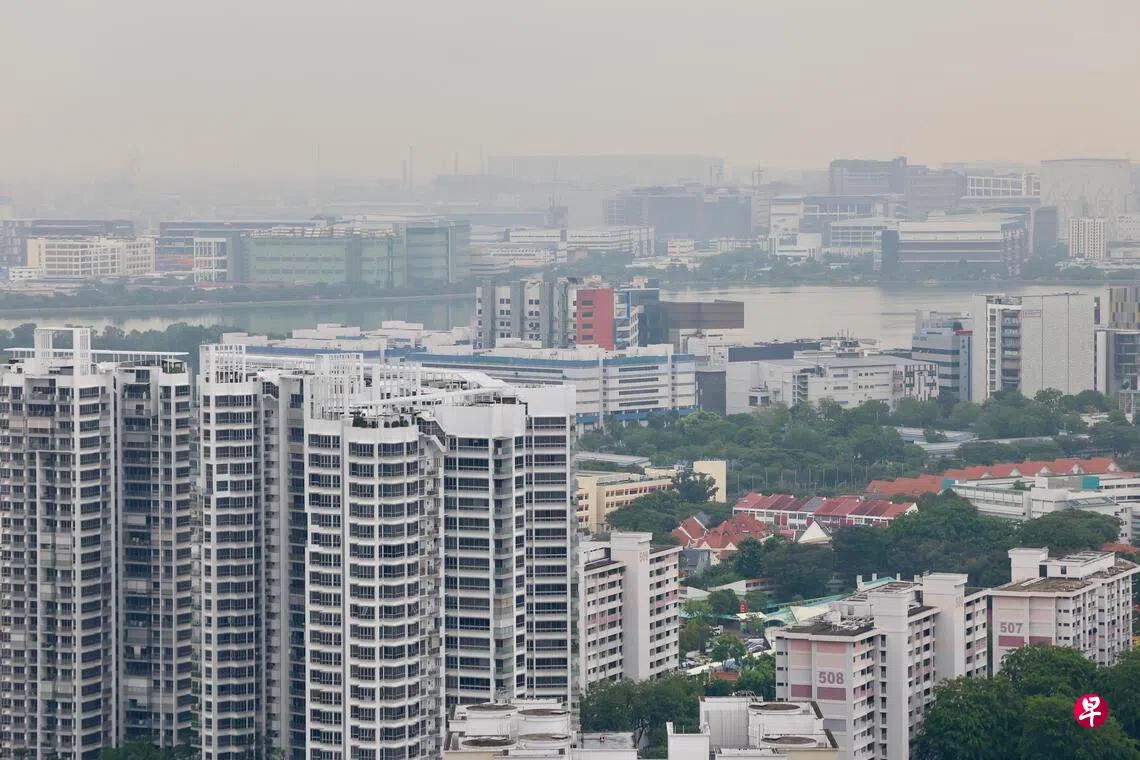
Several Workers' Party MPs proposed that Singapore prioritise suitable forest and peatland projects with credible emissions-reduction benefits when buying carbon credits from other countries, including Indonesia, to help prevent haze pollution.
The Ministry of Sustainability and the Environment introduced amendments to the Transboundary Haze Pollution Act in Parliament on Wednesday (4 November). The bill went through all three readings in a single day, drawing active participation in the debate from several MPs.
Workers' Party Aljunied GRC MP Kenneth Tiong Boon Kiat and Non-Constituency MPs Andre Low Wu Yang and Eileen Chong Pei Shan, all said that when trading carbon credits with countries such as Indonesia, Singapore should prioritise wetland peatlands with water-level monitoring systems, or project sites with sound fire monitoring, prevention and firefighting measures.
Concerns that tougher law could trigger backlash and harm Singapore's business-friendly environment
Sembawang West MP Poh Li San expressed concern that the new measures under the amended Act could trigger a backlash, affecting Singapore's relations with its neighbours and harming its business-friendly environment. In particular, companies under investigation by the Singapore government for clearing land by burning may have substantial business interests in neighbouring countries. If convicted, they would be held accountable under Singapore law. A tougher haze law could affect companies managing land in Indonesia and even lead some businesses to leave Singapore.
Nominated Member of Parliament Associate Professor Kenneth Goh also expressed similar concerns. He suggested strengthening cooperation with other governments, communities and industry organisations to improve land management and fire prevention measures, reducing the risk of forest fires and haze.
Workers' Party Sengkang GRC MP He Ting Ru also said that all responsible financing frameworks, including green financing, should assess the entire company or borrowing group, rather than individual projects or specific loans alone. This would avoid the contradiction of companies obtaining green financing certification while forest fires continued to occur on land they owned.
She also called on GIC and Temasek to formulate and publish policies on haze and forest management. These should include disclosures in their annual reports on investee companies, relevant commitments and how breaches are handled, as well as public disclosures of investments in companies under investigation by Singapore.
How should the ministry assess when to intervene early?
Responding to questions from some MPs on how the authorities would assess haze risks to intervene early under the amended Act, Minister for Sustainability and the Environment Grace Fu said decisions on when to act would continue to be evidence-based. This would include the National Environment Agency's (NEA) ongoing monitoring of regional forest fires and haze, as well as meteorological conditions such as rainfall, wind direction and wind speed.
She said the authorities were strengthening their ability to assess the risk of forest fires and haze affecting Singapore's air quality. They would issue regular forecasts, drawing on scientific evidence and modelling in their analysis.
Fu said, “Should we forecast that there is a reasonable likelihood of air quality deteriorating because of unfavourable meteorological conditions, and that the extent of land and forest fires is significant, NEA will have the basis to exercise a wider range of options without having to prove that the fire in a specific location has indeed caused haze pollution in Singapore.”
MPs including Poh Li San and He Ting Ru also said that Singapore's ASEAN chairmanship next year would allow it to put multilateral cooperation on haze prevention and mitigation on the agenda. This would also be a good opportunity to strengthen the sharing of relevant intelligence across the region.
