

The growth of the semiconductor industry and data centres, along with more electric vehicles on the roads, will drive up Singapore’s electricity consumption. Peak electricity demand is expected to rise by as much as 50% by 2031. To meet this growth, Singapore will develop its energy infrastructure in six areas, including investing up to $5.3 billion to expand the power grid.
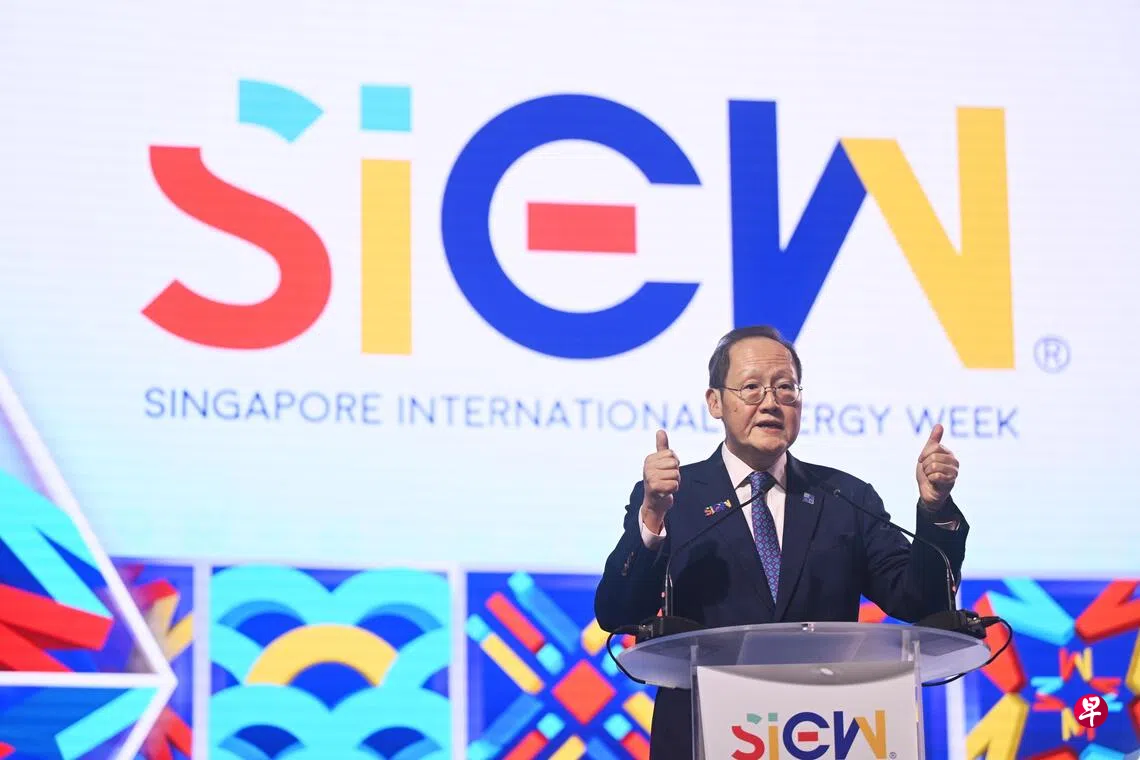
Singapore International Energy Week opened on Monday (26 October). In his keynote address, Minister for Energy, Trade and Industry (Energy and Industry) Dr Tan See Leng announced Singapore’s energy infrastructure development plans for the next five years, covering six areas: the electricity grid, power generation, natural gas, solar deployment, energy storage and low-carbon electricity imports.
Five new power plants over next five years
As of August this year, Singapore’s peak electricity demand stood at 8.6 gigawatts. This is projected to rise to between 9.9 and 13 gigawatts by 2031.
Currently, about 95% of Singapore’s electricity is generated from natural gas. Singapore has more than 20 natural gas-fired power plants with an installed capacity of about 12 gigawatts. Five new plants will be added over the next five years, with total generation capacity expected to increase by 26%.
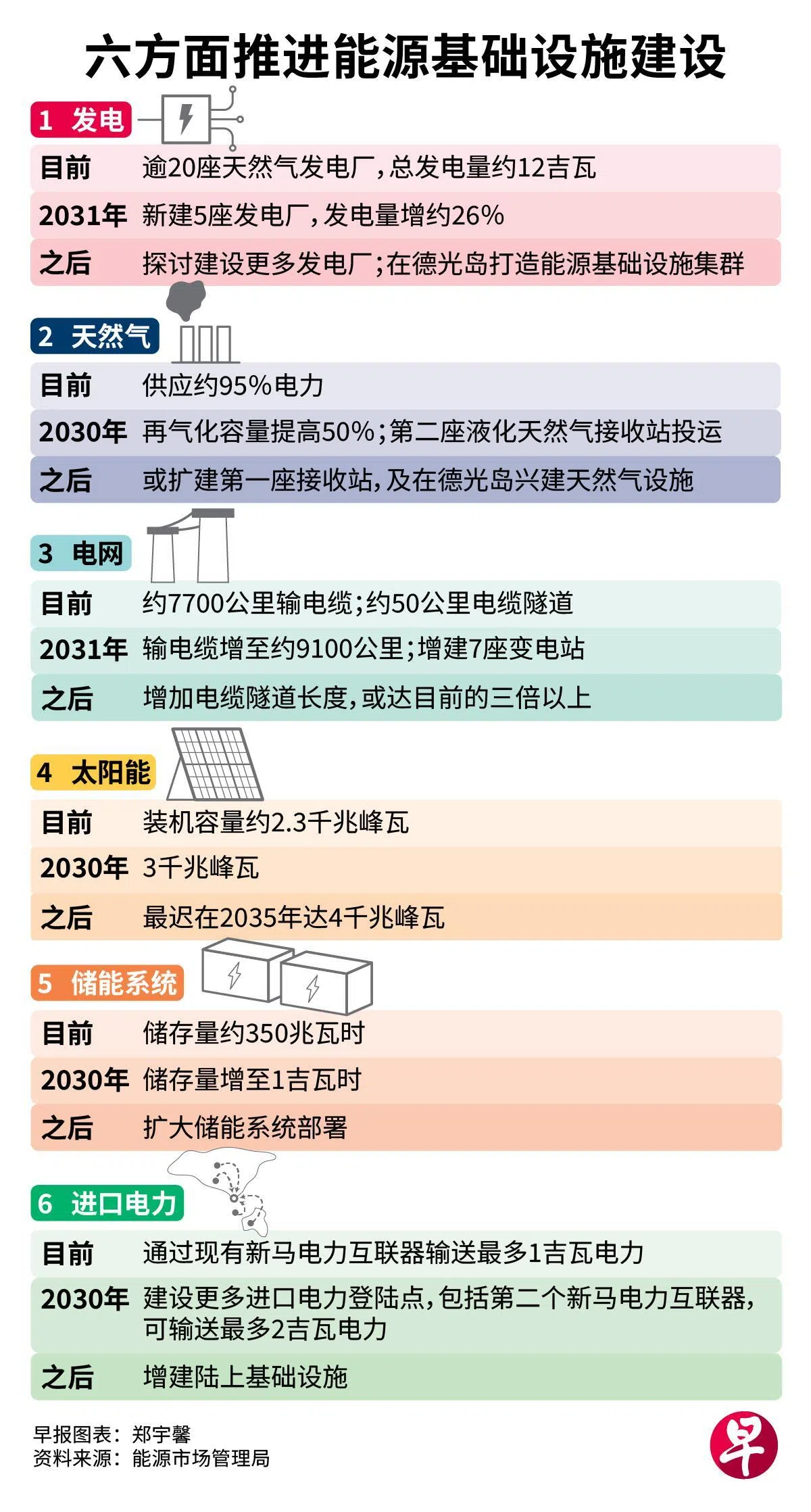
Liquefied natural gas (LNG) accounted for 57% of natural gas imports last year. When Singapore’s second LNG terminal begins operations, expected in 2030, the country’s regasification capacity will rise from 10 million tonnes to 15 million tonnes a year. Regasification involves heating LNG, which is at minus 161 degrees Celsius, to turn it into gas for use as fuel in power plants.
Meanwhile, the authorities are also exploring an expansion of the first terminal, which began operations in 2013.
The electricity grid is essential infrastructure supporting electricity supply, comprising substations, transmission cables and cable tunnels, among other components.
The Energy Market Authority (EMA) began expanding the grid in 2025, with total investment set to reach up to $5.3 billion by 2029 — 11 times the amount invested in the preceding five years.
The investment will fund seven new substations, about 1,400 kilometres of additional transmission cables and improvements to the distribution network to meet new supply and demand requirements arising from developments such as solar power generation and electric vehicle charging.
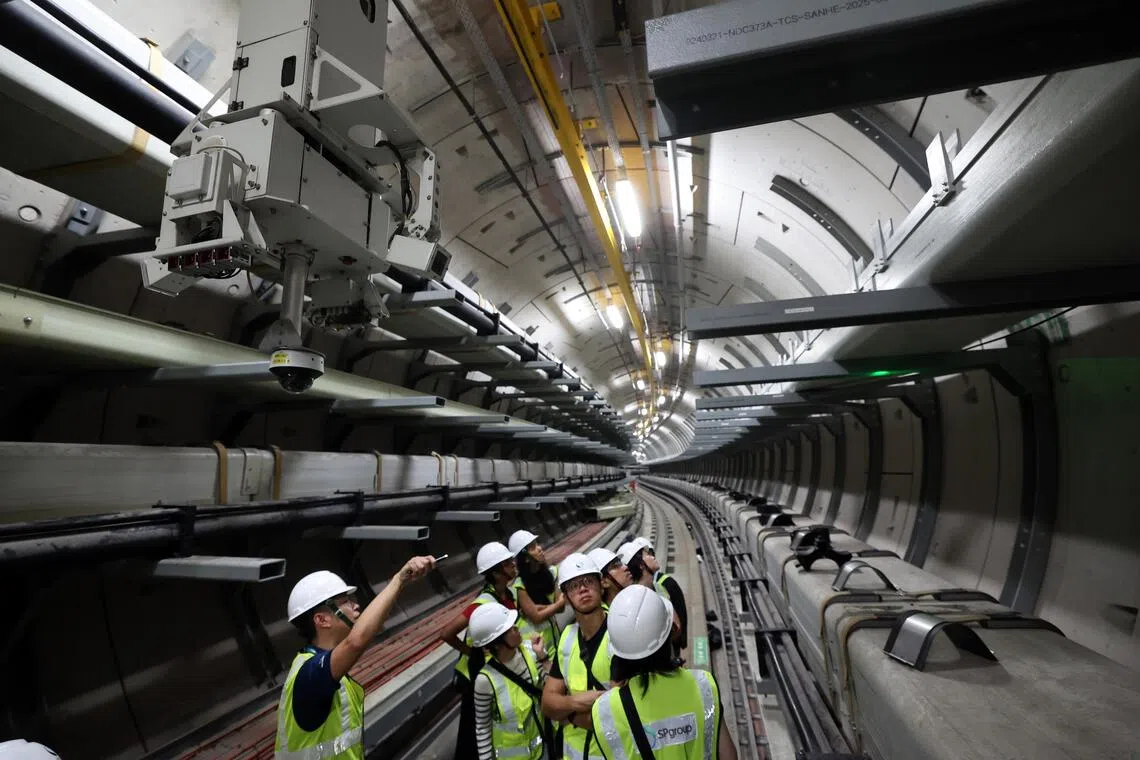
For the longer term, the authorities will also look into a major expansion of the cable tunnel network, aiming to more than triple its current total length of about 50 kilometres. The tunnels lie about 60 metres underground.
Expanding the network will facilitate the installation and maintenance of transmission cables and meet rapidly growing electricity demand in areas such as Pasir Ris and Changi.
Solar deployment target raised to 4 gigawatt-peak by 2035
Singapore is also actively developing alternative energy sources to advance its energy transition and reduce carbon emissions from power generation.
As of the second quarter of this year, Singapore’s installed solar capacity had reached 2.3 gigawatt-peak, putting it on track to meet its target of 3 gigawatt-peak before 2030. Dr Tan announced that the solar deployment target for 2035 would be raised to 4 gigawatt-peak.
For low-carbon electricity imports, Singapore plans to progressively build more landing points connecting subsea cables to the local grid. These plans include a proposed second electricity interconnector between Singapore and Malaysia, with the associated seabed surveys beginning this month.
Sembcorp Utilities gets conditional approval to import 1.3 gigawatts of renewable energy
Sembcorp Utilities also received conditional approval from EMA on Monday to import 1.3 gigawatts of renewable energy, comprising wind power from Vietnam and solar power from Malaysia. Wind power from Vietnam will be transmitted through Malaysia to Singapore, while also supplying Malaysia.
As Singapore introduces more types of renewable energy, fluctuations and intermittency in electricity supply will increase, affecting supply stability.
Singapore therefore plans to raise its energy storage capacity from about 350 megawatt-hours currently to 1 gigawatt-hour, or 1,000 megawatt-hours — equivalent to the annual electricity consumption of 240 four-room HDB flats.
To this end, EMA has released a consultation paper on energy storage systems, inviting industry proposals for practical storage technologies, business models and projects that can be deployed at scale. The deadline is 29 January next year.
Dr Tan See Leng: Energy transition will take costs into account, not pursue decarbonisation at all costs
“Our approach will be anchored in five ‘Cs’: Confidence, Competitiveness, Carbon, Connectivity, and Cost,” Dr Tan said.
“We must ensure our system resilience continues to be a source of confidence, harness energy to bolster our competitiveness, pursue low-carbon energy pathways, and deepen connectivity with our partners. All of this must happen contemporaneously while keeping costs in check.”
On costs, Dr Tan acknowledged that achieving Singapore’s energy transition goals would not be cheap. It would require trade-offs and significant investments, and Singapore must strike the right balance.
He stressed that Singapore would not pursue decarbonisation at all costs, nor at the expense of livelihoods and energy system security.
The government will continue to provide targeted support, including U-Save rebates for households and grants to help businesses improve energy efficiency and lower costs.
