

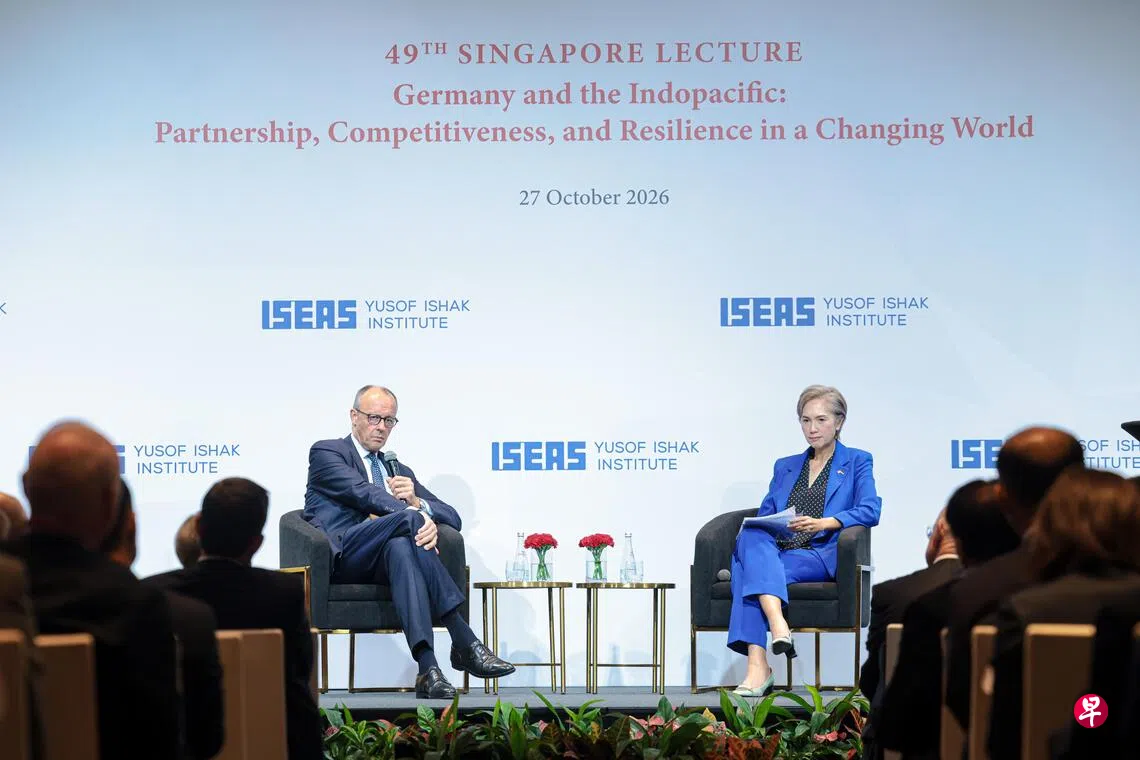
German Chancellor Friedrich Merz supports major regional free trade agreements between the EU and ASEAN, and between the EU and members of the Comprehensive and Progressive Agreement for Trans-Pacific Partnership, to jointly address trade and economic uncertainty arising from intensifying great-power rivalry.
Merz delivered a speech titled “Germany and the Indo-Pacific: Partnership, Competitiveness and Resilience in a Changing World” at the 49th Singapore Lecture, organised by the ISEAS – Yusof Ishak Institute in Singapore, on Tuesday (27 October).
To address mounting trade barriers and supply chain risks, Merz proposed that the EU and ASEAN accelerate efforts to conclude a regional free trade agreement. Next year marks the 50th anniversary of dialogue relations between the two blocs, he said, offering an opportunity to make an all-out push for an EU-ASEAN free trade agreement.
“I am in favor, provided we have enough in common to do it fast,” said Merz.
However, if an agreement cannot be reached in the near term, he advocated pursuing bilateral free trade agreements with willing ASEAN member states first.
Merz also called for a major cross-regional agreement between the EU and members of the Comprehensive and Progressive Agreement for Trans-Pacific Partnership (CPTPP), to better reflect the close links between multinational supply and production chains.
Together, he noted, the two sides account for more than a third of global trade. Greater coordination would enable them to respond more effectively to practices that violate free and fair trade.
In the field of frontier technologies, Merz identified humanoid robots and frontier artificial intelligence (AI) as priorities for future cooperation. He acknowledged that Europe was still heavily dependent on American companies in new technologies, including AI.
By drawing on the knowledge and technological strengths of Singapore, Japan and South Korea, Europe could catch up with the US more quickly.
De-risking, not decoupling, from China
Outlining his key policies on China, Merz firmly reiterated that de-risking and diversification did not mean decoupling: “Decoupling would be a mistake. It would make us neither safe nor more prosperous.”
He advocated de-risking and diversification to identify and reduce unhealthy one-way dependencies in supply chains, technology and raw materials. This applies to China as it does to other great powers.
Merz also said remedial measures were needed when systemic overcapacity, export restrictions or market access barriers distorted competition.
Germany and France have put forward an initiative at the European Council to address unfair competition and protect the legitimate interests of Europe’s economy, without targeting any particular country.
On the Russia-Ukraine war, Merz urged China to use its influence over Moscow to promote a just peace, noting that Asia was watching Ukraine’s fate closely.
“It is absolutely not acceptable that one day, Russia, perhaps China, and the US find a way to bring this war to an end without having Ukraine at the table,” he warned.
Europe must also be involved in negotiations, as its participation would be essential to security guarantees following a ceasefire.
In her welcome address, Minister for Digital Development and Information Josephine Teo, who chaired the Singapore Lecture, stressed Germany’s indispensable role in the Indo-Pacific.
Teo said Germany is one of ASEAN’s most important trading partners and the largest exporter of goods to Southeast Asia. Its deep expertise in precision engineering, advanced manufacturing, research and development, and innovation makes it an ideal partner for Southeast Asian countries seeking cooperation in deep tech, physical AI and industrial AI.
More importantly, as the international order comes under pressure and trade barriers rise, Germany remains a reliable partner in upholding international law, supporting free trade and building economic resilience.
This is Merz’s first visit to Singapore since he became German Prime Minister in May last year. He will travel on to Japan and South Korea.
