

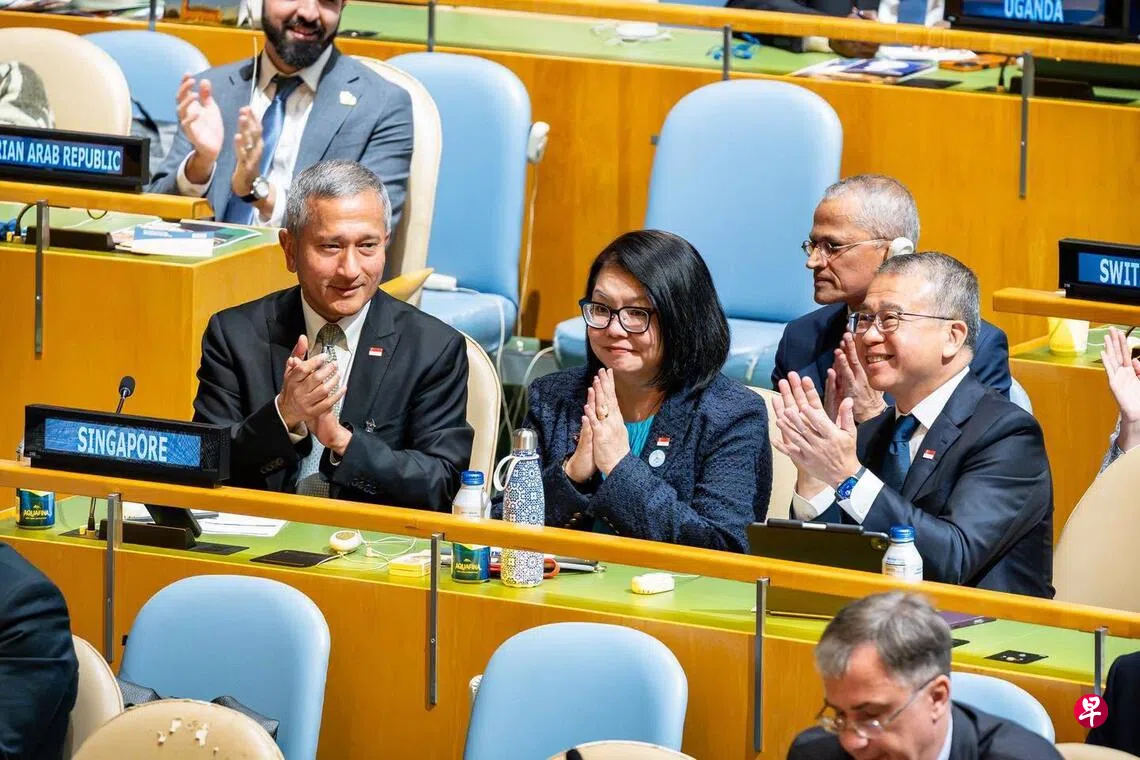
Singapore’s Ambassador-at-Large and Ambassador for International Law Rena Lee has been elected a judge of the International Court of Justice (ICJ) with strong support, becoming the first Singaporean and the first woman from Southeast Asia to hold the post.
Singapore’s political leaders congratulated her, saying the historic achievement reflected the international community’s trust in Lee and Singapore. It also underscored the importance of upholding international law and supporting the peaceful resolution of disputes amid today’s volatile global landscape.
Based in The Hague in the Netherlands, the ICJ is the principal judicial organ of the United Nations (UN). It comprises 15 judges who serve nine-year terms, with elections for five seats held every three years. The most recent election took place at UN headquarters in New York at 11pm Singapore time on Tuesday (3 November).
In the first round of voting, Lee, 57, topped the UN General Assembly ballot with 151 votes. In the Security Council ballot, she tied for first place with French candidate François Alabrune with 13 votes. She was elected an ICJ judge with an absolute majority in both bodies.
Prime Minister Lawrence Wong congratulated her in a Facebook post on Wednesday (4 November), describing it as a historic and proud moment for Singapore.
PM Wong remarked that Lee was the first Singaporean and the first woman from Southeast Asia to be elected an ICJ judge. Her strong showing reflected broad international support for her candidacy and the trust countries placed in her.
“For small States like Singapore, a rules-based international order is fundamental to our sovereignty, security and prosperity,” said PM Wong.
Senior Minister Lee Hsien Loong also congratulated Lee in a Facebook post, wishing her well as she takes up her appointment next February.
Foreign Minister Dr Vivian Balakrishnan described it in a Facebook post as an extraordinary achievement and a moment of deep pride for Singapore.
Dr Balakrishnan said it was especially meaningful for a small country such as Singapore. “At a time when international law and the rules-based multilateral system are under increasing strain, Rena’s election underscores the importance of strong international institutions and the contributions that small states can make on the world stage.”
Edwin Tong: Rena Lee remains warm, principled and down-to-earth
Lee is a seasoned international law expert with more than 30 years of experience. Her expertise spans the law of the sea, environmental law, international humanitarian law and human rights law. The Ministry of Foreign Affairs (MFA) and the Ministry of Law (MinLaw) nominated her as a candidate for election to the ICJ in July this year.
Minister for Law and Second Minister for Home Affairs Edwin Tong said on Facebook that he had supported Lee throughout her candidacy. Over the months, he had seen her remain composed and steadfast, showing resilience and determination as she engaged governments, understood their concerns and aspirations, and reflected them in her work.
“And despite all that she has achieved, she remains the same Rena I have known since our days in law school — warm, thoughtful, deeply principled and wonderfully down-to-earth. And still happiest with a good bowl of fishball noodles!”
Rena Lee: Mindful of heavy responsibility, determined to honour trust
Following her election, Lee released a video message to the media through MFA, thanking the two ministers for their congratulations. She described the result as a collective effort by Team Singapore and thanked colleagues at MFA and MinLaw, particularly staff at Singapore’s mission in New York, for their support and assistance during the campaign.
She became emotional at one point in the video: “I am so proud to call myself a member of Team Singapore… I am very, very aware and conscious of the heavy responsibility and the trust that you have placed on me, and I will do my utmost to fulfill that responsibility and trust.”
Jayakumar: Election reflects Singapore’s support for ICJ
Tommy Koh: We must uphold a world ruled by law, not force
Former Deputy Prime Minister Professor S. Jayakumar told Lianhe Zaobao (LHZB) that it was important for Singapore to show its support for key international institutions at a time when the international order and international organisations were being called into question.
“The ICJ is one of the principal organs under the UN Charter. Nominating Rena as a judge shows our support for the ICJ.”
In 2007, Jayakumar led Singapore’s legal team in presenting its case to the ICJ in the sovereignty dispute with Malaysia over Pedra Branca. In 2008, the court ruled that sovereignty over Pedra Branca belonged to Singapore.
The ICJ comprises independent judges who do not represent the governments of their own or any other country. Jayakumar said that following her election, Lee would have to discharge her duties independently and impartially in accordance with the court’s rules. “I am confident she will prove to be an excellent ICJ judge.”
Former Ambassador-at-large Professor Tommy Koh, who was also Singapore’s agent in the Pedra Branca case, attributed the election result to three factors in an interview: “Good candidate, good country, good campaign.”
When asked whether international law could continue to protect small states in the current climate, Koh responded with a question: what was the alternative — a lawless world, or one ruled by force?
“No matter how imperfect, we must vote for a world ruled by law and not by force.”
